FREE Sketch Fire Safety Icon: Hand-Drawn Clarity for Real-World Safety Needs
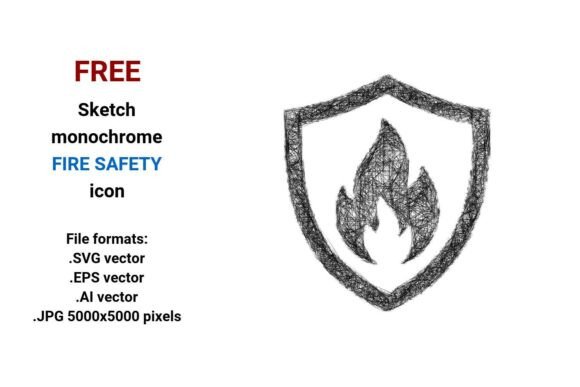
If you’ve ever tried to add a fire safety notice to a classroom poster, drop an intuitive button into a safety training app, or print clear evacuation instructions for your small café — and found stock icons too stiff, too generic, or too pixelated when scaled — the FREE Sketch Fire Safety Icon is built for exactly that moment. It’s not just another clipart download. It’s a set of four versatile, editable files — .SVG, .EPS, .AI, and high-res .JPG (5000×5000 pixels) — all in a warm, confident sketch style: rough pencil lines, intentional imperfections, and hand-drawn authenticity that signals “human attention,” not robotic automation.
Why Sketch Style Works Where Other Icons Fall Short
A fire safety icon isn’t decorative — it’s functional communication. In real life, that means people glance, interpret, and act fast. A polished, glossy icon might look sharp on a corporate website, but in a kindergarten hallway or a community center workshop, a sketch-style icon feels more approachable, less intimidating, and easier to remember. Teachers use it in laminated safety checklists because kids recognize the scribble-like quality as “drawn by someone like them.” Safety officers embed it into internal PDFs and slide decks where vector scalability matters — no blurring when zoomed during a projector presentation. And because it’s vector-based, every curve, line, and outline stays razor-sharp whether printed on a 3×5-inch door hanger or blown up across a 10-foot safety banner.
Where This Icon Fits — Without Asking Permission
You don’t need design experience to benefit from the FREE Sketch Fire Safety Icon. You just need a real need — and here’s where it shows up:
- Educators & Trainers: Drop the .SVG into Canva or PowerPoint to build custom fire drill flowcharts. The sketchy line art pairs naturally with student-made posters — no visual mismatch between “teacher-designed” and “kid-drawn.”
- Small Business Owners: Add the .JPG version to your Google Business profile “Services” section, or use the .AI file to overlay it cleanly onto branded signage at your salon, gym, or co-working space — reinforcing that fire prevention is part of your daily care, not just compliance.
- Freelance Designers & Developers: Import the .EPS or .SVG directly into Figma, Adobe XD, or Webflow as a scalable fire safety button for client dashboards, safety portals, or emergency alert UIs. No raster scaling headaches. No licensing surprises — it’s truly free for commercial use.
- Nonprofits & Community Groups: Print the .JPG at full resolution on flyers for neighborhood fire prevention workshops. The black-and-white sketch style prints clearly on recycled paper, saves ink, and keeps focus on the message — not the medium.
- Bloggers & Content Creators: Use the icon as a subtle recurring visual motif in posts about home safety, apartment readiness, or wildfire prep. Its hand-drawn, artistic sketch icon aesthetic adds warmth without sacrificing clarity — especially helpful when explaining technical topics like smoke detector placement or fire extinguisher types.
What “Vector” Really Means for Your Workflow
When we say this is a vector image, we mean it’s built from math — not pixels. That’s why the .SVG, .EPS, and .AI files let you resize infinitely, recolor with one click, or isolate individual elements (like the flame or fire extinguisher outline) for customization. Need to match your brand’s exact blue? Change the stroke weight for web vs. print? Swap the sketch texture for a cleaner line art version? All possible — because these aren’t flattened images. They’re living design assets. Even the high-res .JPG serves a purpose: quick insertion into email newsletters, social graphics, or platforms that don’t support vector uploads — all while retaining crisp detail thanks to its 5000×5000-pixel resolution.
Real Things to Consider Before You Use It
This icon works best when its style aligns with your context — not every safety document needs sketch energy. If you’re designing official municipal evacuation maps or regulatory compliance documents, a stricter, ISO-standard icon may be required. But for internal comms, awareness campaigns, educational tools, or user-facing digital interfaces? The sketch fire safety icon builds trust through relatability.
Also: while it’s free, double-check your intended use case against any platform-specific guidelines (e.g., some app stores prefer specific icon dimensions or contrast ratios). And if you’re layering it over photos or busy backgrounds, test legibility — the outline sketch icon relies on contrast, so avoid placing it over similarly textured or dark areas without a subtle white stroke or background shape.
More Than Just an Icon — A Practical Safety Signal
The FREE Sketch Fire Safety Icon quietly supports fire protection and fire prevention goals by making safety feel human-scale. It doesn’t shout. It invites attention. That sketchy, pen-drawn quality says, “This matters — and it’s for people, not paperwork.” Whether you’re updating your office’s fire exit map, building a safety module for remote staff, or helping kids draw their own home escape plan, this icon meets you where you are — with flexibility, clarity, and zero friction.
It’s not about replacing code-compliant signage. It’s about extending the conversation — in classrooms, break rooms, blogs, apps, and community centers — where awareness begins long before an emergency happens. And because it comes in four formats, you’re never choosing between quality and convenience. You get both — instantly, freely, and ready to use.
Who Benefits Most — and How
Freelancers save hours tweaking icons in Illustrator. Educators make safety feel inclusive, not intimidating. Small business owners communicate vigilance without sounding bureaucratic. Bloggers turn dry topics into visually grounded stories. And everyday users — parents, renters, volunteers — get a tool that’s simple enough to use today, yet robust enough to grow with their needs. That’s the quiet power of a well-designed, genuinely free resource: it removes barriers so safety can spread — not stall — in the places that matter most.