FREE Sketch Ambulance Icon: Hand-Drawn Clarity for Modern Interfaces
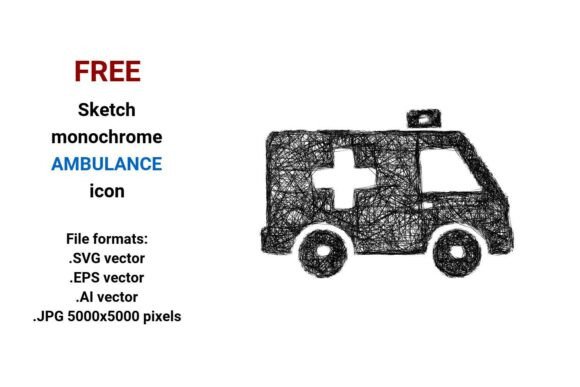
When urgency meets design, clarity isn’t optional—it’s critical. The FREE Sketch Ambulance Icon answers that need with a purpose-built, black-and-white handdrawn aesthetic that communicates emergency, medical response, and trusted action—without visual noise. Unlike photorealistic or overly polished icons, this set embraces intentional imperfection: subtle line variation, organic curves, and the quiet authority of a pen-on-paper gesture. It’s not just an ambulance icon—it’s a recognizable signal, optimized for interfaces where speed, empathy, and legibility intersect.
Why Sketch Style Resonates in Today’s Digital Ecosystem
Design trends have quietly pivoted from sterile minimalism toward human-centered expression. Users now respond more readily to interfaces that feel approachable, trustworthy, and grounded—not just efficient. A sketched ambulance icon fits seamlessly into this shift: it suggests immediacy without alarm, professionalism without coldness, and care without clutter. Healthcare apps, telemedicine dashboards, first-responder training platforms, and community safety portals all benefit from icons that balance seriousness with warmth.
This isn’t about nostalgia—it’s about cognitive fluency. Studies in UI/UX show that handdrawn or sketch-style pictograms improve recall and reduce interpretation time in high-stakes contexts, especially when paired with consistent color coding (like black-and-white contrast). That’s why the FREE sketch black and white ambulance icon works so well as an emergency vehicle button on mobile-first tools: its monochrome simplicity ensures readability at any scale, under any lighting condition, and across diverse devices.
Four Formats, One Flexible Foundation
The practical strength of this resource lies in its format versatility:
- .SVG vector: Ideal for web interfaces, responsive dashboards, and interactive prototypes—lightweight, scalable, and natively supported by all modern browsers.
- .EPS vector: A reliable choice for print-ready materials like emergency procedure posters, training manuals, or public signage where CMYK fidelity matters.
- .AI vector: Fully editable in Adobe Illustrator—perfect for designers who need to adjust stroke weight, tweak curvature, or integrate the icon into larger branding systems.
- .JPG (5000x5000 pixels): High-resolution raster output for presentations, reports, or legacy systems that don’t support vector imports—retaining crisp detail even when zoomed or projected.
Together, these formats cover the full spectrum of real-world use—from rapid prototyping in Figma (via SVG import) to final asset handoff for print production (using EPS or AI). No conversion headaches. No quality loss upon scaling. Just consistent, editable, and production-ready handdrawn vector icon assets.
Vector Intelligence Meets Emergency Context
A vector image isn’t just “scalable”—it’s structurally intelligent. Built from mathematical equations rather than fixed pixels, it defines points, lines, and Bezier curves. That means your ambulance button can appear at 24px in a mobile navigation bar or stretch across a 12-foot safety kiosk display—identical in proportion, clarity, and intent. For emergency services organizations updating digital infrastructure, this reliability reduces maintenance overhead and eliminates pixelation-related misinterpretation risks.
Crucially, the sketch style doesn’t compromise precision. Each curve is deliberate. Each line termination reflects controlled pressure—mimicking the confidence of a trained responder’s gesture. That’s why it reads as both doodle style icon and professional design element. It bridges informal usability and formal trust—a rare duality in medical or emergency interface design.
Real-World Applications Beyond the Obvious
While healthcare and emergency response teams are natural users, the utility extends further:
- Educators building CPR or first-aid e-learning modules use the icon as a visual anchor—its sketch style lowers cognitive load for learners processing complex procedures.
- Freelance UI designers incorporate it into dashboard kits for municipal safety platforms, where consistency across emergency vehicle categories (police, fire, ambulance) matters—but differentiation is equally vital.
- Nonprofits launching community health campaigns pair the icon with plain-language messaging—its rough, minimal sketch icon aesthetic signals authenticity, not corporate polish.
- Hardware startups developing smart EMS wearables or IoT-enabled defibrillators use the SVG version to render cleanly on low-DPI embedded displays.
Even small business owners managing clinic websites or urgent-care landing pages find value: the icon functions equally well as a button, a pictogram, or a graphic beside contact information—no redesign needed when switching between desktop and tablet layouts.
Editing, Adapting, and Integrating With Confidence
Because it’s delivered as editable vector files (.AI and .EPS), customization is straightforward—not theoretical. Need to adjust stroke thickness for better contrast on a dark-themed app? Done in seconds. Want to align the icon’s baseline with other interface elements? Easily achievable. Prefer to recolor it for accessibility testing (e.g., high-contrast yellow-on-black)? The vector structure preserves integrity during fills and gradients.
That editability also supports localization. In multilingual environments, pairing the icon with translated labels (e.g., “Ambulancia” or “Ambulance”) becomes more effective when the visual symbol remains culturally neutral yet universally legible—an advantage over stylized or region-specific illustrations.
Design Ethics and Practical Empathy
Using a sketched ambulance icon isn’t just a stylistic choice—it’s a subtle act of alignment with user needs. In moments of stress, ambiguity increases cognitive load. A clean, uncluttered, black-and-white emergency vehicle mark cuts through noise. Its lack of shading, texture, or decorative flourish honors the user’s mental bandwidth. That’s usability grounded in empathy—not trend-chasing.
It also respects technical constraints common in public-facing tools: older devices, limited bandwidth, assistive technologies. SVG files load faster than high-res PNGs; monochrome icons render reliably across screen readers and voice-navigation systems when paired with proper ARIA labels (e.g., aria-label="Emergency ambulance service"). This makes the FREE Sketch Ambulance Icon not just visually appropriate—but ethically sound.
Getting Started Is Intentionally Simple
No registration. No watermarks. No attribution required. The download includes all four formats in a single ZIP—ready for immediate integration into Sketch, Figma, Adobe XD, Illustrator, or even static HTML pages via inline SVG. Because the files are native vectors, there’s no risk of accidental rasterization or compression artifacts during export.
For developers, embedding the SVG directly allows dynamic interactivity—hover states, animation on click, or conditional coloring based on system status (e.g., “available,” “en route,” “busy”). For designers, the AI file opens paths to create custom icon families—extending the same sketch language to stethoscopes, heart symbols, or trauma kits.
In a landscape where generic icon libraries often blur meaning under visual sameness, this handdrawn ambulance icon stands apart—not because it’s flashy, but because it’s focused. It serves a precise function with quiet authority. And in emergency contexts, quiet authority is exactly what users need.