Why the FREE Sketch Fitness Tracker Icon Is Reshaping Digital Design for Health-Tech Creators
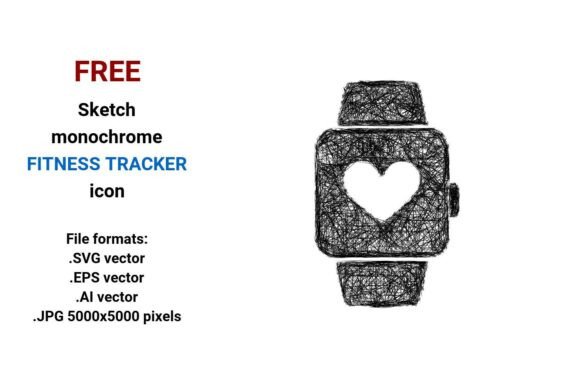
In today’s fast-evolving digital health landscape, visual language matters more than ever—not just for user experience, but for brand authenticity, creative flexibility, and cross-platform scalability. At the intersection of wellness, technology, and design lies a quietly powerful asset: the FREE Sketch Fitness Tracker Icon. More than a simple graphic, it’s a versatile, hand-drawn vector toolkit built for professionals who demand both artistic integrity and technical precision—whether you're launching a fitness app, designing a wearable dashboard, or building a wellness SaaS interface.
A Vector Asset Designed for Real-World Creative Workflows
The FREE Sketch Fitness Tracker Icon isn’t just another clipart download. It’s delivered in four production-ready file formats: .SVG vector, .EPS vector, .AI vector, and a high-resolution .JPG (5000x5000 pixels). This multi-format approach reflects how modern designers, developers, and marketers actually work—switching fluidly between Figma, Adobe Illustrator, web development environments, and print-ready assets.
Unlike raster images that blur when scaled, a vector image is built from mathematical equations defining points, lines, and curves. That means whether you’re placing the icon on a 4K smartwatch UI, embedding it in an SVG-based dashboard, or printing it on a conference banner—it retains razor-sharp clarity at any size. For teams iterating rapidly across devices and touchpoints, this isn’t convenience—it’s operational efficiency.
Beyond Aesthetics: Why “Sketch Style” Fits Today’s Fitness-Tech Expectations
Consumers no longer respond to sterile, overly polished interfaces alone. There’s a quiet but unmistakable shift toward human-centered design—interfaces that feel intentional, approachable, and grounded. The sketch line icon aesthetic delivers precisely that: a subtle nod to ideation, authenticity, and process. Its rough sketch icon texture—deliberately imperfect curves, visible pencil strokes, and organic line weight—communicates warmth without sacrificing professionalism.
This resonates powerfully in the fitness tracker space, where trust and relatability are critical. Users don’t just track steps—they track progress, setbacks, motivation, and identity. An artistic sketch icon signals empathy; it suggests the tool was designed *with* people, not just *for* them. Brands like WHOOP, Garmin, and emerging indie apps increasingly layer hand-drawn elements into onboarding flows and data visualization—blending analytical rigor with human narrative. The FREE sketch black and white fitness tracker icon fits seamlessly into that ethos: minimalist enough for clean UIs, expressive enough to carry emotional weight.
Practical Adoption Across Roles and Industries
Let’s move beyond theory—and look at how real professionals integrate this resource into daily work:
- Freelance UI/UX designers use the .SVG vector version to build responsive icon systems for health-tech clients—scaling effortlessly from mobile buttons to desktop analytics panels.
- Marketing teams repurpose the .JPG (5000x5000) file for social media carousels, email headers, and presentation decks—ensuring pixel-perfect fidelity even in large-format exports.
- Entrepreneurs launching wearable companion apps drop the .AI vector into their design system library, then tweak stroke width, color, or negative space to match evolving brand guidelines—no need to commission custom illustrations.
- Educational content creators embed the .EPS vector into printable infographics about activity tracking metrics—leveraging its compatibility with legacy print workflows while preserving editable layers.
What ties these use cases together isn’t just format versatility—it’s editable craftsmanship. Each file retains full vector editability: anchor points, Bezier curves, and layered paths remain intact. That means designers aren’t locked into static visuals. They can adapt the outline sketch icon to match new interaction states (e.g., active vs. inactive tracker), align with updated typography, or extend it into a full sketch icon set for consistency across an entire product suite.
Aligning With Broader Shifts in Technology and Lifestyle
The rise of the activity tracker as a cultural touchpoint has transformed how we visualize personal data. No longer confined to wristbands and apps, fitness insights now appear in smart mirrors, AR coaching sessions, corporate wellness dashboards, and even mental health journals. As the use cases diversify, so do the visual expectations.
At the same time, the line between “consumer tech” and “professional tool” continues to blur. A physical therapist may use a tablet-based fitness tracker button during client sessions; a school wellness coordinator might project an activity tracker icon during a PE lesson; a remote team leader could embed the same icon into a Slack status or Notion habit tracker. In each case, the icon must communicate function *and* intent—clearly, quickly, and consistently.
That’s where the FREE Sketch Fitness Tracker Icon delivers strategic value. Its hand drawn quality avoids the coldness of over-automated visuals, while its scalable vector foundation ensures technical reliability. It bridges two essential needs: the human desire for approachability, and the professional requirement for precision.
Designing for Tomorrow’s Interfaces—Today
Looking ahead, interface design is moving toward greater contextual awareness: icons that adapt to time of day, user state, or ambient lighting. While the current FREE sketch black and white fitness tracker icon is monochrome by design, its vector structure makes future adaptations straightforward—whether recoloring for dark-mode interfaces, animating stroke-drawing effects for onboarding micro-interactions, or combining with other sketch style assets to build cohesive visual libraries.
Moreover, as AI-powered design tools mature, editable vectors become even more valuable. Generative interfaces often require clean, layered source files to iterate intelligently—making resources like this fitness tracker vector foundational infrastructure, not just decorative elements.
Final Thought: Tools Are Only as Powerful as Their Context
The FREE Sketch Fitness Tracker Icon succeeds not because it’s technically flawless—but because it’s contextually intelligent. It understands that fitness is no longer just about biometrics; it’s about behavior, identity, and community. It knows that technology must serve humanity—not obscure it. And it recognizes that creative professionals need assets that accelerate work *without* constraining vision.
Whether you’re refining a healthcare dashboard, prototyping a new wearable concept, or building educational materials around physical literacy—the drawn fitness tracker, editable sketch icon, and artistic sketch icon offer more than visual shorthand. They offer alignment: between craft and utility, between trend and timelessness, between what users need—and how designers deliver it.
For teams committed to meaningful digital health experiences, this isn’t just another icon download. It’s a small, scalable, intentional step toward better interfaces—and a more human-centered future.