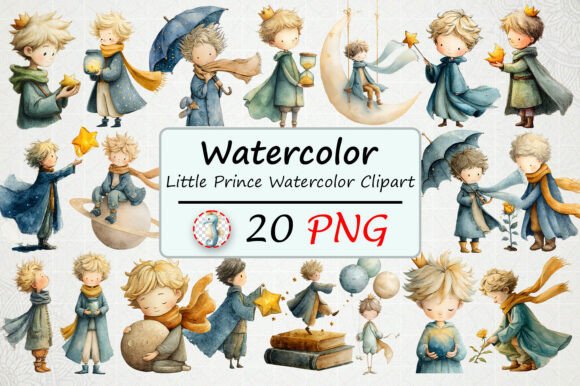
Watercolor Little Prince Clipart: A Strategic Creative Asset for Purpose-Driven Projects
Watercolor Little Prince clipart isn’t just decorative—it’s a precision tool for communicators, makers, and brand builders who value emotional resonance alongside technical flexibility. Rooted in the enduring symbolism of Antoine de Saint-Exupéry’s beloved story—the fox, the rose, the stars, the little prince himself—these illustrations carry quiet narrative weight. When rendered in soft watercolor textures and delivered as high-fidelity digital assets, they become more than icons: they’re versatile, emotionally intelligent design elements that support intentionality across physical and digital touchpoints.
Why This Collection Delivers Strategic Value Beyond Aesthetics
Each design arrives at 300 DPI resolution, with transparent backgrounds and standard sizing—meaning no guesswork during scaling or layering. That technical consistency matters when you’re building brand-aligned product lines (e.g., limited-edition mugs for a bookstore café) or developing educational printables for a literature curriculum. Unlike generic clipart, Watercolor Little Prince clipart carries built-in thematic coherence: themes of wonder, care, perspective, and quiet courage translate seamlessly into messaging for wellness brands, mindful educators, boutique publishers, or ethical lifestyle businesses.
The ZIP folder structure ensures immediate usability—not distraction. You don’t need to hunt through nested folders or convert file formats. Everything opens cleanly in Adobe Illustrator, Photoshop, Canva, Cricut Design Space, or Silhouette Studio. That operational efficiency compounds over time: a freelance designer preparing five greeting card mockups saves 20+ minutes per project when assets load reliably and scale without pixelation. For small business owners managing their own marketing, that’s not convenience—it’s capacity regained.
Where Intentional Use Creates Real Impact
Consider these grounded applications—not as isolated ideas, but as interconnected opportunities:
- Greeting cards and stationery: A single watercolor star or planet design can anchor an entire suite—ensuring visual continuity while allowing copy to shift tone (e.g., “You are my rose” for a wedding invite vs. “Look up—and remember your own stars” for a graduation card).
- Sublimation products: Because each file is 300 DPI with transparency, placement on curved surfaces like mugs or tumblers remains crisp—even when resized to fit ergonomic zones. No blurred edges, no manual background removal.
- Educational resources: Teachers and curriculum designers use these motifs to illustrate abstract concepts—like using the fox’s “taming” metaphor to introduce relationship-building in SEL programs—or embedding subtle constellations in reading comprehension worksheets to reinforce theme analysis.
- Packaging and branding: A minimalist watercolor rocket or baobab branch works as a foil stamp on kraft paper boxes or a delicate watermark behind product descriptions—adding sophistication without overwhelming the message.
What ties these uses together isn’t just visual appeal—it’s alignment. Watercolor Little Prince clipart supports goals only when selected deliberately: to evoke, not decorate; to clarify, not complicate; to connect, not distract.
Planning Your Use: Three Practical Considerations
Before downloading or dropping a design into your next layout, ask yourself:
- What outcome does this serve? If the goal is customer retention, a subtle watercolor fox motif on a loyalty program thank-you card reinforces emotional reciprocity. If the goal is classroom engagement, pairing a watercolor desert landscape with open-ended journal prompts invites deeper reflection than clipart used purely as filler.
- Does it integrate—or interrupt? Test contrast, scale, and spacing early. A large watercolor rose may dominate a poster meant to highlight event details—unless the rose *is* the focal point of the campaign. Use the transparent background to layer thoughtfully: try placing text over low-opacity versions of the artwork, or use clipping masks to shape content within the illustration’s contours.
- Is it scalable across contexts? Verify how the design performs at thumbnail size (for social media), at 8.5” x 11” (for printables), and on a 4” x 6” surface (for stickers or tags). Because these files are vector-friendly and high-resolution, they hold up—but only if you preserve their native proportions and avoid aggressive JPEG compression in export.
Risks of Using Watercolor Little Prince Clipart Without Context
Even high-quality assets can dilute impact when deployed without strategic framing. The most common missteps include:
- Tone mismatch: Using whimsical watercolor stars in a formal financial services report undermines credibility. The Little Prince speaks to imagination and humanity—but only when the surrounding context invites that language.
- Overuse without variation: Repeating the same fox icon across ten different email headers signals template reliance, not brand cohesion. Instead, rotate between three complementary motifs (e.g., fox, rose, asteroid B-612) to maintain recognition while avoiding fatigue.
- Ignoring licensing scope: These files are licensed for commercial use—including resale on physical goods—but not for redistribution as standalone clipart or inclusion in design asset subscriptions. Clarity here protects both your reputation and your legal standing.
None of these risks stem from the clipart itself—they arise from decisions made outside the download folder. Watercolor Little Prince clipart reflects your intent back to you. It amplifies clarity when chosen with purpose—and magnifies ambiguity when used reactively.
Long-Term Value: Building With, Not Just On, These Assets
Think of this collection not as a one-time resource, but as foundational vocabulary. Over six months, a small publisher might use the same watercolor constellation motif across a book cover, chapter dividers, author newsletter headers, and limited-run bookmarks—creating a subtle, cumulative brand signature. A therapist developing printable self-reflection tools could anchor each worksheet with a different Watercolor Little Prince symbol (the well, the train, the lamplighter), turning visual repetition into therapeutic scaffolding.
That kind of consistency doesn’t happen by accident. It happens when you treat each design as a decision point—not a decoration. When you audit your current projects and ask: “Which of these would benefit from quiet symbolism? Where does warmth matter more than polish? Where does simplicity serve the message better than complexity?” That’s where Watercolor Little Prince clipart earns its place—not as background noise, but as intentional voice.
Getting Started—Without Overcommitting
You don’t need to redesign everything at once. Start small:
- Replace one stock photo in your next client presentation with a watercolor planet or telescope—then note how the audience’s attention shifts during storytelling sections.
- Print two designs on matte cardstock, cut them by hand, and use them as tactile prompts in a team workshop on values alignment.
- Add a watercolor starburst behind a key quote in your next blog post—and track whether dwell time increases on that section versus others.
Measure what matters to your goals—not downloads or likes, but resonance, recall, and response. Watercolor Little Prince clipart gives you permission to slow down, choose meaningfully, and build with texture—not just speed.
This collection is digital-only. No physical item ships. What arrives instead is leverage: clean files, thoughtful symbolism, and the space to decide—not what looks nice, but what serves.