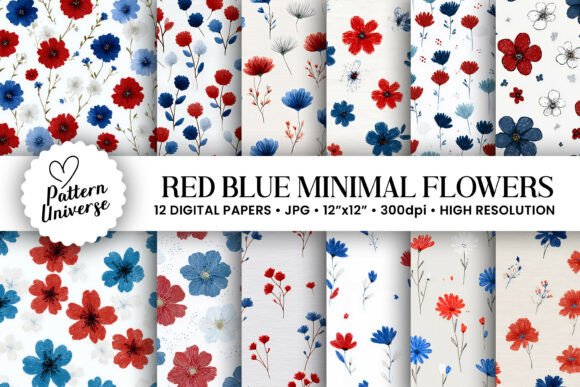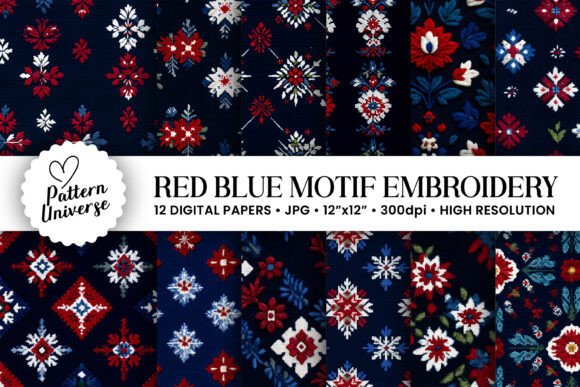
Red Blue Motif Embroidery Pattern
If you’ve ever held a hand-stitched sampler or admired the quiet rhythm of cross-stitch on linen, you’ll recognize the warmth and intention behind the Red Blue Motif Embroidery Pattern. This isn’t just a repeatable design—it’s a visual language rooted in craft tradition, softened by modern digital precision. Think crisp navy anchors beside cherry-red floral sprigs, delicate French knots rendered as subtle texture, and folk-inspired motifs arranged with balanced asymmetry. The palette stays tightly curated: deep cobalt, muted cerulean, brick red, and dusty rose—no neon, no pastel washouts. Each motif carries gentle imperfection—slightly uneven stems, staggered stitch lines, faint thread shadows—all preserved at 300dpi so they scale cleanly from a 2″ gift tag to a 24″ wall print.
Where This Pattern Earns Its Keep
This collection thrives where authenticity meets utility. It’s not background noise—it’s a quiet signature. On greeting cards, the red-blue contrast ensures legibility without shouting; layered under serif type like Playfair Display or Lora, it grounds sentimental messaging with tactile credibility. For small-batch product packaging—think artisan soap boxes or candle labels—the pattern adds artisanal weight without requiring actual embroidery labor. Tumbler wraps benefit from its seamless flow: no awkward breaks at the seam, no pixelation when wrapped around curved surfaces. And for junk journalers or scrapbookers? These 12 patterns offer built-in cohesion. You’re not stitching together unrelated elements—you’re working within a single, intentional visual family.
More Than Just Pretty Repeats
What makes this set especially useful for professionals isn’t just resolution or quantity—it’s consistency of voice. Each of the 12 designs shares the same underlying structure: a 12″ × 12″ canvas, identical DPI, uniform color depth, and deliberate negative space. That means you can drop Pattern #3 into a Canva invitation template and Pattern #9 into an Adobe InDesign editorial spread—and your brand won’t look fragmented. There’s no guessing whether “vintage” here means distressed ink or stitched linen; the Red Blue Motif Embroidery Pattern defines that vocabulary clearly. That kind of reliability matters when you’re building recognition across touchpoints: a newsletter banner, a trade show backdrop, a limited-run sticker sheet—all pulling from the same quiet, confident source.
Real Pairings, Not Guesswork
Don’t overthink font pairing—start simple. A clean, slightly warm sans serif like Poppins or Nunito works beautifully over these patterns because it doesn’t compete. Let the embroidery carry texture; let the type carry clarity. If you need hierarchy, use weight (not size alone): bold for names, regular for dates, light italic for handwritten-style notes. For logo lockups or monogrammed tags, try overlaying a thin-line script—something with modest contrast and open counters, like Quicksand or Caveat—but keep it minimal. One line. One color. Let the pattern breathe underneath. Avoid overly decorative serifs or condensed display fonts—they’ll tangle visually with the motif’s fine details. And if you’re printing on kraft paper or textured cardstock? Test first. The red tones may shift subtly depending on substrate absorbency; the blue tends to hold more consistently.
Practical Checks Before You Use It
These are digital papers—not vector motifs—so treat them as high-fidelity raster assets. That means they’re ideal for print layouts, social media banners, and physical crafts, but less suited for logo marks that need infinite scalability. All 12 files are delivered in RGB .PNG format inside a single ZIP—no PSD layers, no AI vectors, no fonts included. That’s intentional: this is a design *background*, not a toolkit. Licensing is straightforward: commercial use is permitted, including resale on physical products (like printed stationery or fabric-wrapped journals), but you may not redistribute the files themselves or claim authorship of the pattern design. If you're integrating into a client project, confirm their usage rights align—most small businesses and solopreneurs are covered, but enterprise platforms sometimes require extended licenses.
A Few Quiet Strengths Worth Noting
The Red Blue Motif Embroidery Pattern avoids trend fatigue. It doesn’t lean into maximalism or minimalist austerity—it occupies a grounded middle ground. That makes it durable across seasons and campaigns. A wedding invitation suite using these papers feels timeless, not dated. A boutique coffee shop’s seasonal menu board gains warmth without seeming twee. Even in digital spaces—like Instagram story templates or Pinterest pins—the pattern reads clearly at small sizes thanks to its strong value contrast and uncluttered spacing. And because the motifs are Ai-generated but carefully art-directed (not auto-filled or randomly tiled), there’s variation without chaos: one pattern might emphasize geometric stars, another soft trailing vines—but all share the same stitch-weight logic and color restraint.
Getting Started Is Light Work
Unzip. Open your design app. Drag one file onto your canvas. Scale to fit. Adjust opacity if layering text (try 85–92% for softness). Save a version with transparent text boxes for future edits. That’s it. No plugins, no tutorials, no learning curve. What you gain is time—time you’d otherwise spend sourcing, editing, or licensing disparate assets. Time you can redirect toward writing better copy, refining your product photography, or simply stepping back to assess whether the overall composition *feels* right. Because ultimately, good design isn’t about stacking features—it’s about choosing assets that behave predictably, support your message, and disappear just enough to let your content shine.
- All 12 patterns are 3600 × 3600 pixels at 300dpi—print-ready out of the gate
- No repeating seams or visible tile edges—each is truly seamless
- Designed for real workflows: greeting cards, tumbler wraps, junk journal pages, wall art prints, scrapbook kits
- Works equally well in Adobe Creative Suite, Affinity apps, Canva, and Procreate
- Licensed for commercial use—including physical product creation and client deliverables