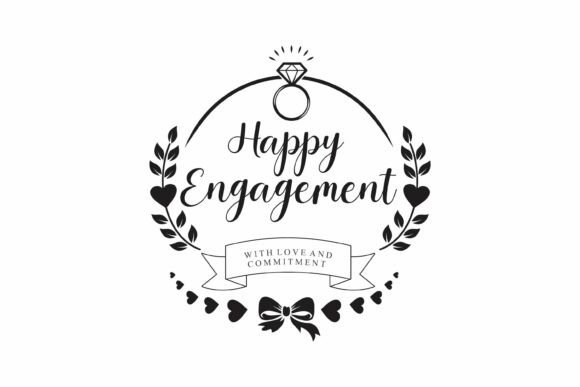
Happy Engagement Lettering
Happy Engagement Lettering isn’t just decorative text—it’s a visual tone of voice. It’s the kind of hand-drawn or stylized typography that conveys warmth, sincerity, and joyful intention. Think of it as lettering designed to resonate emotionally: rounded forms, gentle curves, open spacing, and subtle personality—never stiff, never cold. It’s ideal for moments that matter: weddings, proposals, milestone announcements, heartfelt brand messaging, or any context where authenticity and emotional connection are priorities.
Why It Works Where Other Styles Fall Short
Unlike generic script fonts or overused calligraphy bundles, Happy Engagement Lettering carries narrative weight. Its strength lies in its balance—playful but not childish, elegant but not formal, personal but still legible and scalable. Designers reach for it when they need typography that supports human-centered storytelling—not just fills space.
It’s especially effective in digital-first environments where attention is fragmented. A well-crafted Happy Engagement Lettering piece stands out in an Instagram story, anchors a wedding website header, or adds quiet confidence to a boutique product label. It doesn’t shout—it invites.
Creative Possibilities You Can Start With Today
You don’t need to master calligraphy to use Happy Engagement Lettering meaningfully. Here are grounded, adaptable directions:
- Custom name pairings: “Alex & Jordan” with interlocking flourishes and soft shadowing—ideal for save-the-date prints or engraved keepsakes.
- Milestone phrases: “Forever Starts Now”, “Let’s Begin”, or “Yes, a thousand times”—designed with intentional rhythm and breathing room between words.
- Minimalist variations: Clean sans-serif bases softened with one expressive element—a looping ‘y’, a heart-shaped dot on the ‘i’, or a single watercolor wash behind the phrase.
- Contextual layering: Pair the lettering with subtle botanical line art, delicate gold foil textures, or muted linen backgrounds—keeping focus on readability and mood.
What makes these approaches work isn’t complexity—it’s consistency in intent. Every curve, weight shift, and spacing decision reinforces the feeling of genuine celebration.
Real-World Uses Across Audiences and Platforms
Wedding professionals use Happy Engagement Lettering to unify stationery suites—invitations, menus, signage—without relying on stock templates. A single custom lettering file becomes the visual throughline across print and digital touchpoints. For example, a designer might create one master layout in AI (Adobe Illustrator), then export clean EPS and CDR versions for different vendors: EPS for high-res print shops, CDR for local sign makers using CorelDRAW.
Small business owners apply it to brand launches or seasonal campaigns—think “Our First Year Together” on limited-edition packaging or “You’re Invited” on a café’s summer patio banner. Because the style feels personal, it helps humanize service-based brands like therapists, educators, or financial planners who want to signal approachability without sacrificing professionalism.
Bloggers and content creators integrate it into social media graphics—especially Reels thumbnails or Pinterest pins—where warm, distinctive typography increases dwell time and shareability. A short phrase like “Start Here” or “You Belong” in Happy Engagement Lettering performs better than standard fonts because it signals care in craft.
Educators and workshop facilitators adapt it for classroom posters or digital handouts—“Growth Takes Time”, “Ask Questions”, or “Try Again”—infusing encouragement with visual warmth that resonates with both teens and adult learners.
Working Smart With File Formats: EPS, AI, and CDR
Having Happy Engagement Lettering in multiple editable formats isn’t about redundancy—it’s about flexibility and control. Each format serves a purpose:
- .AI files let you edit layers, adjust anchor points, recolor strokes, or scale infinitely in Adobe Illustrator—ideal if you’re refining spacing or adapting the layout for different sizes.
- .EPS files ensure compatibility across older design software and print workflows. They preserve vector fidelity and embed fonts correctly, making them trusted by professional printers worldwide.
- .CDR files (CorelDRAW) matter if you collaborate with designers or vendors using that ecosystem—common in signage, embroidery digitizing, or regional print shops outside major metro areas.
Always keep your original layered AI file backed up. Export flattened EPS and CDR versions for sharing—but never delete the source. That way, if you need to tweak kerning for a vertical Instagram post or add a new language variant next year, you’re three clicks away from doing it cleanly.
Keeping Your Work Clear, Consistent, and Audience-Friendly
Happy Engagement Lettering shines when it serves the message—not the ego. To stay grounded:
- Test legibility at real-world sizes: View your design at 30% zoom (simulating mobile screens) and 150% zoom (for large-format prints). If letters blur or merge, simplify stroke contrast or increase tracking.
- Anchor it with neutral supporting type: Pair your Happy Engagement Lettering with a simple, highly readable sans-serif (like Inter, Lato, or Montserrat) for body copy. This creates hierarchy—and avoids visual fatigue.
- Respect cultural context: If adapting for bilingual audiences, avoid ligatures or connected scripts that break across languages. Design separate but harmonized versions—one for English, one for Spanish or Arabic—rather than forcing one layout to do too much.
- Stay within your brand palette: Warm tones (terracotta, oat, sage) often complement this style best—but don’t assume. Test against your actual background colors. A soft grey-on-cream may read clearer than peach-on-ivory under certain lighting.
Originality comes not from reinventing every curve, but from thoughtful adaptation: adjusting baseline angles for better rhythm, choosing one signature detail (a tapered terminal, a lifted crossbar), and applying it consistently across all uses.
Getting Started Without Overwhelm
You don’t need to commission custom lettering to begin. Many designers offer licensed Happy Engagement Lettering sets with commercial-use rights—including full EPS, AI, and CDR access. Look for packs that include:
- Multiple weights (light, regular, bold) for dynamic hierarchy
- Alternate characters (swash capitals, contextual ligatures)
- Matching icons or decorative elements (hearts, leaves, ribbons)
- Clear licensing terms covering digital, print, and resale contexts (e.g., for wedding planners selling coordinated kits)
Then pick one project—just one—and apply it with intention. Redesign your email newsletter header. Update your portfolio hero section. Create a printable affirmation card for your students. Let the lettering support what you’re already doing, rather than becoming another thing to manage.
Happy Engagement Lettering works best when it feels earned—not applied, but chosen. When it reflects something true about the people, moment, or message it represents. That’s where usefulness meets resonance. And that’s where your next idea begins.