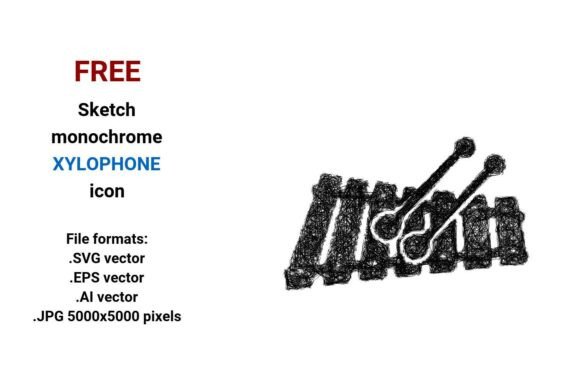
FREE Sketch Xylophone Icon: A Versatile, Scalable Resource for Designers and Educators
If you're building a music education app, designing a creative dashboard, or crafting a playful brand identity for a children’s studio — the FREE Sketch Xylophone Icon is more than just a visual asset. It’s a practical, expressive tool that bridges function and feeling. Unlike generic clipart or overused stock icons, this sketch-style xylophone carries warmth, authenticity, and clarity — all while delivering professional-grade technical flexibility.
What Makes This Icon Stand Out (Beyond the “Free”)
This isn’t just another xylophone icon. It’s a sketch xylophone icon — drawn with intentional hand-drawn texture, subtle pencil-like strokes, and clean negative space. That “sketchy” quality makes it feel human and approachable, especially in contexts where perfection feels cold or overly corporate. And because it’s delivered in four formats — .SVG vector, .EPS vector, .AI vector, and .JPG (5000×5000 pixels) — it adapts seamlessly whether you’re coding a responsive UI or printing a 24-inch poster.
A vector image like this one is built from mathematical paths, not pixels. That means you can scale it to fit a tiny mobile button or blow it up across a classroom wall — no blurriness, no jagged edges. Whether you’re using it as a mallet instrument button in a music theory app or as part of a line xylophone icon set in a teacher’s lesson-planning dashboard, the fidelity stays sharp.
Real-World Uses You Might Not Expect
Designers often reach for icons when they need to communicate quickly — but context changes everything. Here’s where the FREE Sketch Xylophone Icon shines beyond the obvious:
- Educational Software & Apps: Music teachers use it as a xylophone button in interactive rhythm trainers. Its sketch style helps signal “activity” or “play mode” — subtly encouraging engagement without overwhelming young learners.
- Early Childhood Branding: Daycares, preschools, and toy companies incorporate it into logos or website navigation. The monochrome, pen-drawn icon aesthetic pairs beautifully with soft color palettes and conveys creativity without clutter.
- Music Therapy Interfaces: Clinicians building custom digital tools for neurodiverse clients appreciate its clear outline and isolated composition. It reads instantly at small sizes and remains legible on low-resolution tablets used in therapy sessions.
- UI Kits & Dashboard Systems: Product teams developing music production software or school administration platforms use it as a vector xylophone in sidebar navigation or status indicators — especially when consistency across icon styles matters more than photorealism.
- Printed Learning Materials: Because the JPG version is high-res (5000×5000), it works flawlessly in PDF workbooks, laminated flashcards, or classroom posters — no pixelation, even under bright projector light.
Who Benefits Most — And Why
UX designers love the editable vector files (.SVG, .EPS, .AI) because they can recolor, resize, or tweak stroke weight in seconds — no need to hunt down a designer every time branding shifts. The sketch xylophone icon fits naturally into software sketch icon libraries or ui kit collections where cohesion matters.
Music educators rely on its clarity and recognizability. A child doesn’t need to decode abstract shapes — the mallets, bars, and frame are unmistakably xylophone. That’s critical in environments where visual literacy varies widely — think ESL classrooms or special needs settings.
Small business owners (like independent music instructors or makers of handmade percussion instruments) use it in Canva presentations, Etsy shop banners, or email newsletters. The hand drawn, freehand look adds personality without requiring illustration skills — and the isolated, outline format drops cleanly onto any background.
Things to Keep in Mind Before You Use It
While versatile, the FREE Sketch Xylophone Icon works best when matched thoughtfully to your project’s tone and audience. Here’s what to consider:
- Contrast matters: Since it’s monochrome and line-based, test it against your background colors — especially light grays or pastels. If it fades visually, try adding a subtle drop shadow or adjusting stroke weight in your vector editor.
- Consistency counts: If you’re building an icon system, pair it with other sketch style icons — not photorealistic or flat-design ones. Mixing styles can unintentionally confuse users about hierarchy or interactivity.
- Accessibility note: As a line icon, it’s highly legible, but always pair it with text labels in interfaces (e.g., “Xylophone Mode”) for screen readers and cognitive clarity.
- JPG vs. vector: Use the JPG only for static print or web displays where editing isn’t needed. For anything interactive, scalable, or color-flexible — stick with SVG, EPS, or AI. The JPG won’t scale down smoothly for tiny mobile buttons.
Why “Sketch” Isn’t Just a Style Choice — It’s a Signal
In design, “sketch” does more than look casual. It signals openness, process, and invitation. A sketch xylophone button feels less like a command and more like an invitation to explore. That nuance matters in learning tools, creative apps, or community-driven platforms — places where users benefit from feeling like co-creators, not passive consumers.
It also avoids cultural or stylistic baggage. Unlike highly stylized or cartoonish xylophones, this pen drawn icon stays neutral — appropriate for academic institutions, global edtech platforms, or minimalist branding systems. And because it’s rooted in real-world mallet instrument anatomy (bars, resonators, mallet placement), it supports accurate musical understanding — not just decoration.
How It Fits Into Broader Creative Workflows
Think of this icon as a building block — not an endpoint. You can:
- Import the .SVG directly into Figma or Adobe XD and adjust stroke width, color, or spacing to match your design system.
- Open the .AI file in Illustrator to convert strokes to outlines, add gradients, or combine it with other percussion icons (like marimba or vibraphone) for a full music toolkit.
- Use the .EPS version for legacy print workflows — it’s still widely supported by commercial printers and large-format plotters.
- Drop the high-res .JPG into PowerPoint decks, Google Slides, or printed handouts without worrying about compression artifacts.
No matter how you use it, the FREE Sketch Xylophone Icon stays true to its roots: functional, expressive, and quietly thoughtful — a small but meaningful piece of visual language for anyone working at the intersection of music, education, and design.