FREE Sketch Fish Icon: Clean, Scalable & Versatile
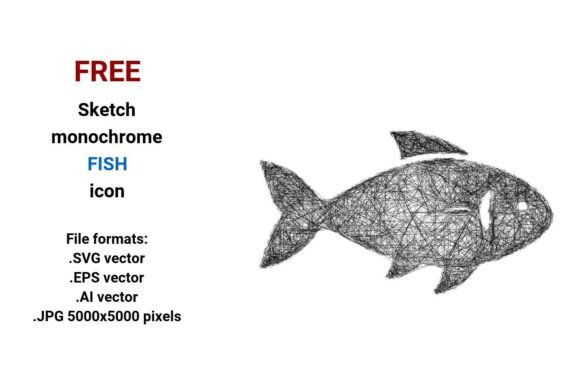
Need a fish icon that feels expressive yet professional? The FREE Sketch Fish Icon delivers exactly that — a hand-drawn, black and white fish illustration designed for clarity, flexibility, and creative control. Unlike generic clipart or over-polished stock icons, this one balances organic line work with technical precision. It’s not just a fish; it’s a design element built to adapt — whether you’re labeling an ocean-themed app, illustrating a marine biology lesson, or designing eco-friendly packaging.
Why a Sketch-Style Fish Icon Works Where Others Don’t
A sketch aesthetic brings warmth and approachability without sacrificing usability. In digital interfaces, education materials, or printed collateral, a sketch fish icon signals authenticity and human touch — valuable when communicating themes like sustainability, exploration, or natural science. Its black-and-white outline ensures high contrast on any background, and the deliberate “rough” quality avoids looking sterile or AI-generated. That matters most when your audience values craftsmanship — think educators crafting classroom posters, small business owners building brand identity, or freelancers developing custom dashboards.
Four File Formats, One Practical Workflow
The FREE Sketch Fish Icon comes in four formats: .SVG, .EPS, .AI, and .JPG (5000×5000 pixels). Each serves a distinct role:
- .SVG: Ideal for websites, apps, and responsive layouts. Scales infinitely without blurring, loads quickly, and supports CSS styling (e.g., hover color changes on a fish button).
- .EPS and .AI: Native vector formats for designers using Adobe Illustrator or compatible tools. You can recolor, reshape, or combine elements — perfect for customizing a sea fish icon to match brand guidelines or layering it into complex illustrations.
- .JPG: High-resolution raster version for print, presentations, or platforms that don’t support vectors. At 5000×5000 pixels, it holds crisp detail even on large-format posters or exhibition banners.
This multi-format access means you’re not locked into one use case. A blogger can drop the SVG directly into a WordPress post; a teacher can paste the JPG into a Google Slides deck; a graphic designer can open the AI file to tweak stroke weight or integrate it into a full ocean fish icon set.
Real-World Uses Beyond Decoration
Icons are functional tools — not just visual garnish. Here’s how users actually apply the FREE Sketch Fish Icon:
- Educators embed it into worksheets about marine ecosystems — its clean line art sketch style helps students focus on anatomy and classification, not stylistic distractions.
- Small business owners use the .AI version to create consistent branding across menus, signage, and social media — pairing the sketch fish button with handwritten fonts reinforces artisanal, locally sourced messaging.
- Web developers leverage the SVG’s lightweight nature to build interactive navigation — imagine a “Sea Life” category menu where each icon pulses subtly on hover.
- Content creators layer the black-and-white sketch fish icon over photos of coral reefs or aquariums, using transparency to blend without competing visually.
Vector vs. Raster: Why It Matters for Your Project
A vector image is built from mathematical paths — points, lines, curves — not fixed pixels. That’s why the .SVG, .EPS, and .AI versions of this sketch fish icon scale flawlessly from a 16-pixel favicon to a 10-foot trade show banner. If your work involves resizing, editing, or printing at multiple sizes, vector is non-negotiable. The included .JPG is a fallback — excellent for static displays but unsuitable for cropping or enlarging beyond its native resolution.
Keep in mind: while vector files offer maximum flexibility, they require compatible software to edit. If you only use Canva or basic photo editors, the JPG gives immediate usability — and the SVG still works well for web embedding without editing.
Who Benefits Most — and When to Look Elsewhere
This FREE Sketch Fish Icon shines for projects valuing simplicity, scalability, and subtle personality. It’s especially helpful for:
- Designers needing a starting point for custom icon systems
- Non-designers who want professional-looking assets without licensing fees or complexity
- Teams building cohesive visual language around sea, ocean, or aquatic themes
That said, it’s intentionally minimal — a single sea fish icon, not a library. If your project demands multiple species (e.g., tuna, anglerfish, clownfish), seasonal variants, or colored versions, you’ll need supplemental assets. Likewise, if your interface requires strict WCAG-compliant contrast ratios, test the black-and-white outline against your background — while highly legible in most cases, some light-on-light combinations may need adjustment.
Thoughtful Integration Tips
Maximize impact by matching the icon’s tone to your context. Its freehand sketch character pairs naturally with other hand-drawn elements — try combining it with doodle style icon sets for consistent visual rhythm. In UI design, avoid overloading buttons with extra text; let the sketch fish button stand alone as a clear navigational cue. For print, use the EPS or AI file to adjust stroke thickness — thinner lines suit elegant layouts; bolder ones add presence to children’s materials or signage.
And remember: because it’s free and openly licensed for personal and commercial use (always verify the specific license terms upon download), there’s zero friction to experiment. Try it in a mockup, swap it into a live page, or print a test sample — iteration is part of refining how a sketch line icon functions in your unique environment.
A Resource That Grows With Your Needs
The FREE Sketch Fish Icon isn’t just another download — it’s a versatile, future-proof asset. Whether you're sketching wireframes, finalizing a brochure, or prototyping a mobile app, its combination of curved, intentional linework and technical readiness across formats makes it adaptable without compromise. It respects your time, supports your creativity, and communicates clearly — all while staying rooted in the quiet expressiveness of hand-drawn craft. For anyone working with themes of sea, ocean, or aquatic life, it’s a practical, grounded choice that quietly elevates the everyday.