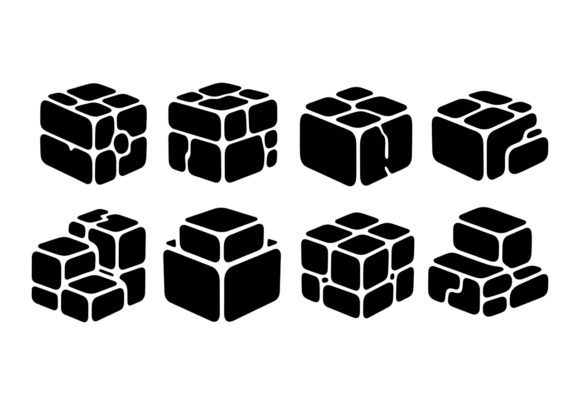
Abstract Cubes Geometric Shapes Vector
If you’ve ever spent hours adjusting a design to fit different product sizes—only to watch edges blur, lines distort, or details vanish—you already understand the quiet frustration of working with raster graphics. That’s where an Abstract Cubes Geometric Shapes Vector changes the workflow. Unlike pixel-based images, this vector file is built from mathematical paths, meaning it scales infinitely without quality loss. Whether you’re printing a 2-inch decal or a 48-inch wall mural, the sharp angles, clean intersections, and balanced negative space of these abstract cubes remain crisp and intentional.
Why geometric abstraction works across mediums—and audiences
Geometric shapes carry visual weight without relying on realism. Cubes, in particular, suggest structure, perspective, and modern minimalism—all while remaining neutral enough to suit diverse aesthetics: tech startups seeking sleek branding, educators building visual learning tools, or crafters designing gender-neutral nursery décor. The Abstract Cubes Geometric Shapes Vector doesn’t impose a mood—it invites interpretation. A single arrangement can read as futuristic on a hoodie, architectural in a gallery print, or playful in a scrapbook layout. That flexibility isn’t accidental; it’s built into the composition’s rhythm—repetition with subtle variation, symmetry with intentional imbalance.
Time saved starts before you open your software
You don’t need to be a vector illustrator to use this file. Because it comes pre-organized—with grouped layers, consistent stroke weights, and non-destructive color swatches—it integrates smoothly into Cricut Design Space, Silhouette Studio, Adobe Illustrator, or even Canva (via PNG import). No tracing, no redrawing, no guessing at spacing. If you’re batch-producing vinyl decals for an Etsy shop, that means cutting setup time drops from 20 minutes per design to under two. For teachers preparing hands-on geometry activities, it means adapting the same cube layout for paper cutouts, digital slides, and laminated manipulatives—all from one source file.
Real-world compatibility, not just technical specs
The inclusion of SVG, EPS, and high-resolution PNG files addresses actual workflow gaps—not marketing checkboxes. SVG works natively in web-based tools and cutting machines that accept direct uploads. EPS ensures backward compatibility with older versions of Illustrator or CorelDRAW—critical if you collaborate with print shops using legacy systems. The PNG version isn’t just “included”—it’s delivered at 300 DPI with transparent background, so it drops cleanly onto mockups, social media posts, or presentation decks without white borders or fuzzy edges. This isn’t about having “more formats”; it’s about eliminating friction when moving between ideation, production, and delivery.
When scalability meets material reality
Scaling a vector doesn’t guarantee success on every surface. A cube pattern that reads clearly on a tumbler may visually collapse on a curved ceramic mug unless spacing and line weight are adjusted. The Abstract Cubes Geometric Shapes Vector includes thoughtful baseline proportions—moderate stroke widths, generous internal clearances—that hold up across common substrates. That said, fabric printing benefits from slightly bolder outlines to counter thread bleed; vinyl application on textured walls may require simplifying overlapping elements. These aren’t flaws in the file—they’re reminders that vectors streamline execution, but material knowledge still guides final decisions.
Who benefits most—and how they use it differently
Small business owners use the file to maintain brand consistency across merchandise without hiring a designer for each variation. One coffee roaster applied the cube motif to bag seals, aprons, and chalkboard signage—keeping their visual language unified while varying scale and color per context.
Educators repurpose the vector to build tactile learning kits: importing into laser-cutting software for wooden 3D puzzle pieces, or converting sections into layered PDFs for spatial reasoning exercises. Because the cubes are constructed from editable paths, individual faces can be isolated and recolored to demonstrate light/shadow or isometric projection.
Hobbyists and DIY crafters appreciate that no design skill is required to achieve professional results—but the file also rewards experimentation. Rotating a single cube group by 15 degrees creates dynamic motion; duplicating and offsetting layers builds depth; combining with hand-lettered phrases adds personality without compromising clarity.
A note on fit and intention
This isn’t a “one-size-fits-all” decorative element. Its strength lies in purposeful restraint: limited visual noise, no gradients or textures, no embedded fonts. That makes it ideal for projects where legibility, reproducibility, or cross-platform reuse matters more than ornamental detail. If your goal is photorealistic texture or hand-drawn charm, a vector like this won’t substitute for those qualities—and shouldn’t try to. But if you value precision, adaptability, and clean visual communication, the Abstract Cubes Geometric Shapes Vector delivers exactly what its structure promises: reliable geometry, ready to serve your intent—not the other way around.
Getting started—without overcomplicating
Open the SVG in your cutting software, resize to match your material dimensions, and send to cut. Or drag the EPS into Illustrator, ungroup to adjust colors, then export for screen printing. For quick social posts, place the PNG over a neutral background in Canva and add a short caption—no alignment tools needed. None of these steps require advanced training because the file respects common workflows instead of forcing users into niche techniques. That practical accessibility—combined with technical robustness—is what turns a “nice design” into a genuinely useful tool.
Ultimately, the value of the Abstract Cubes Geometric Shapes Vector isn’t in its aesthetic alone. It’s in the hours reclaimed, the consistency maintained across touchpoints, and the confidence that comes from knowing your core visual asset won’t break when scaled, converted, or adapted. For creators who balance vision with execution, that reliability isn’t a feature—it’s foundational.